Unusual parasitic
markings on crinoid column
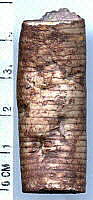
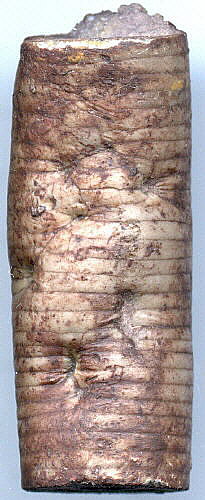
parasitic markings
General abundance: Rare
I have only found four (4) out of hundreds of crinoid columns, with these unusual markings.
Viewer Comments:
I have observed these kinds of markings on crinoid
stems from a number of areas in
the midcontinent and have categorized a lot of them in a couple of papers
I have in
preparation. I have seen them on crinoids from the Barnsdall Formation (Virgilian)
of northeastern Oklahoma and from crinoids from the Stanton Formation in Nebraska,
Kansas and Oklahoma. To my knowledge, I've only observed this kind of (boring?,
cut?, gouge?) on stems of crinoids. I do not recall having seen them of cups
or cup
plates. They may be where sponges anchored to the crinoid. I've not seen any
with
an alignment that would suggest a bite from a fish or cephalopod. I've categorized
these kinds of things as encrusters, borers, slashers, rovers, In some cases,
where
one has found a lot of some kinds of markings on crinoids, specimens have
been
dissolved in acetic or formic acid and phosphatic teeth or radulae have been
found
in the residue, suggesting myzostome worms. Unfortunately, a lot of paleontologists
have simply attributed these markings to myzostomes and I think there are
many
more commensals, parasites, or predators that have left marks on crinoids.
I would
suggest that you might keep some kind of score card or tally on what parasites,
predators or commensals have left their calling cards on all of the fossils
you've
collected from the Lake Neosho. This kind of data, though tedious to gather,
can
really help paint a picture of a very dynamic ecosystem that is preserved
in the
fossil assemblage you are finding there.
Dr. Roger K. Pabian
Those unusual markings on your crinoid stem are from parasites which bore
into
the stem. They are parasitic borings. They aren't common as you stated. There
is
a site in Texas where there are a higher than usual ratio of parasitic bored
stems
to "clean" stems. There are different forms undoubtedly because
there were
different species of parasites whom caused the borings.
I hope this explanation helps you.
Mark Palatas
