Bison Jaw
Age: Pleistocene
Locality: Tulsa County, Oklahoma
Arkansas River (near Sands Springs, OK)
Click on pictures to Magnify
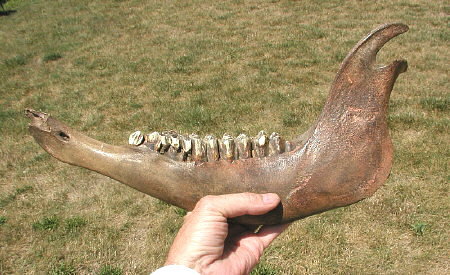 image 1
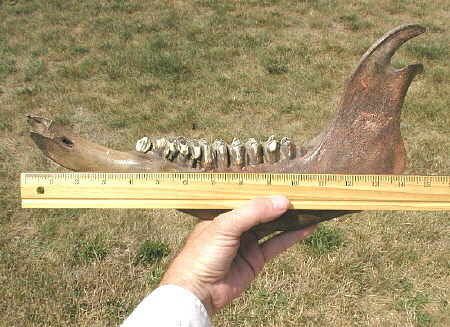 image 2
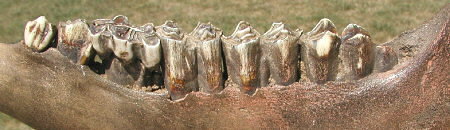 image 3
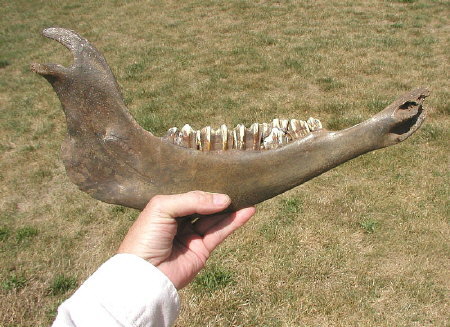 image 4
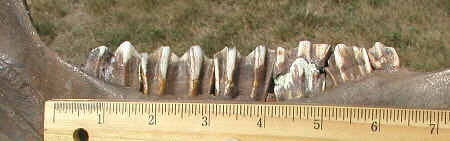 image 5
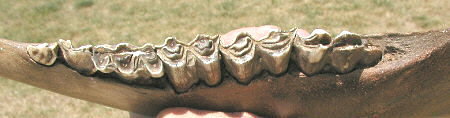 image 6
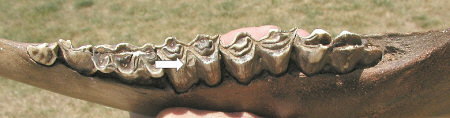 Arrow pointing to stylid
Bison Jaw
Viewer Comments
Your bison was a young adult. The jaw illustrates
how the adult teeth push
and crowd out the deciduous teeth, well-illustrated in image
#5. Osteoclasts
selectively break down the roots of the deciduous tooth as the adult tooth
crowds into the space. The deciduous premolar is preserved as a cap on
the emerging adult tooth; it is fortuitous that the cap was preserved in place.
I also like that this jaw illustrates by wear which
adult cheek teeth emerge
first. The last to emerge is still becoming exposed (very little wear) at
the
rear. Again, image #5
shows this well. This bison was still growing.
In image #6, on the 3rd tooth from the right (which
is adult molar 1), you
can see the stylid on the side of the tooth. It appears as a little "donut"
of
enamel at mid-tooth. The presence of this isolated stylid distinguishes bison
and
cow molars from camel teeth. The overall larger size of the teeth and the
more
robust enamel, including that of the stylid, are features that are used to
distinguish loose bison teeth from cow teeth.
[ image #6
with arrow pointing to stylid ] 
This bison jaw is an excellent specimen for teaching.
It doesn't matter
much whether it is a hundred years old or hundreds of thousands of
years old -- these bison species are very conservative in their morphology.
The main difference between species is size.
I have collected many vertebrate jaws over the years
(among vertebrate
fossils collectors, a "jaw" may be as minimal as a single tooth
in a bit of
bone). The number of jaws I have found with a deciduous tooth cap in
place can be counted on the fingers of one hand. None of them was
nearly as complete as your jaw.
Harry Pristis
Top of page
 Go-Back
Fossil Menu
Other
Fossils (USA and World Wide)